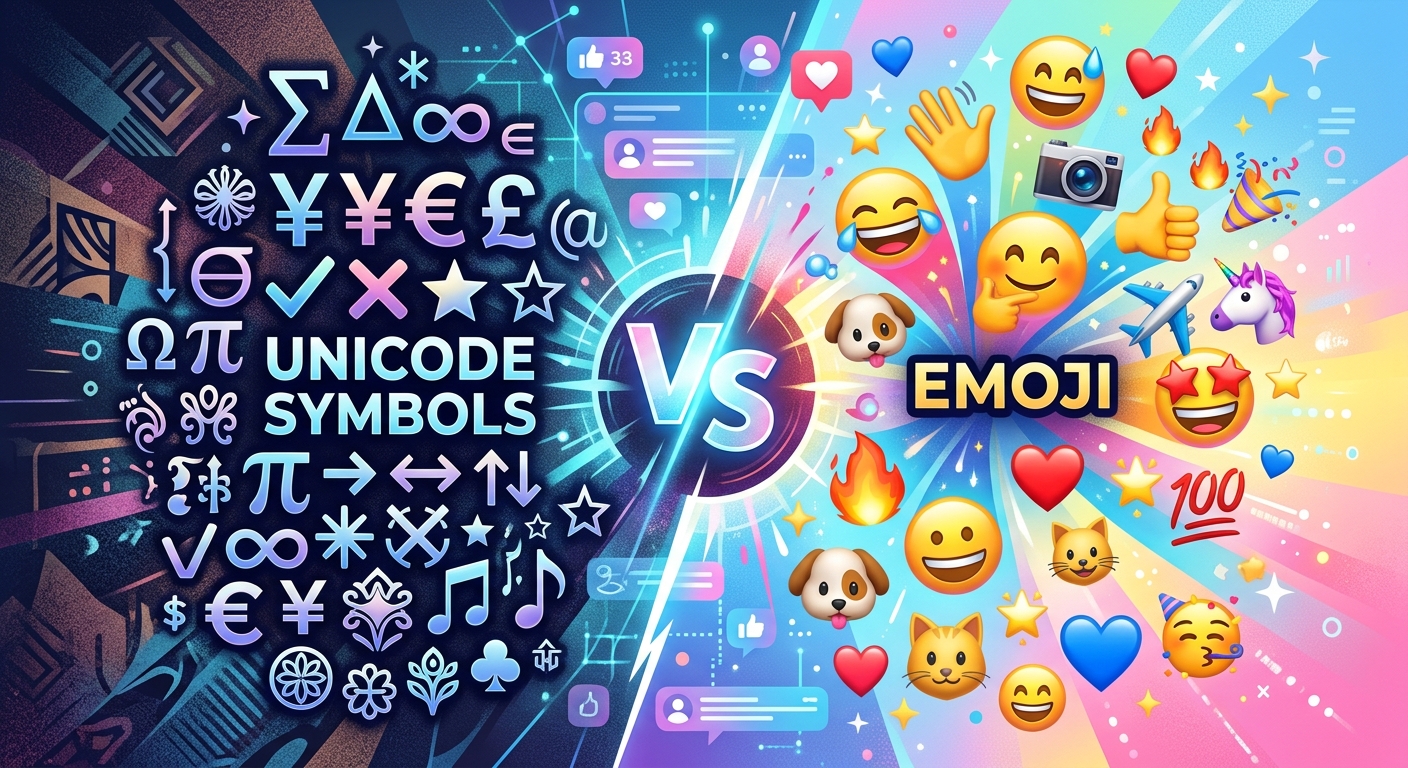
Your Instagram bio looked flawless on your phone. Then someone opened it on a Windows desktop and two of your carefully placed symbols turned into hollow boxes. That frustration happens constantly, and it always traces back to the same core issue: not all characters copy and paste the same way. Some stay crisp and clear on every screen. Others depend entirely on the device doing the reading. Knowing which type of character you are working with changes the quality of everything you post.
At a Glance
- Unicode text symbols are drawn by the device's font, so they render consistently across platforms
- Emoji are rendered as images by each operating system, and their appearance shifts between devices
- Instagram bios and Discord statuses favor Unicode for predictable, portable styling
- TikTok captions benefit from emoji's visual weight and instant emotional tone on mobile screens
- Mixing both types works best when Unicode handles structure and emoji handles emphasis
What Sets Unicode Text Symbols Apart from Emoji
Unicode is a universal character encoding standard. The Unicode Consortium, the organization that governs it, assigns a unique code point to every character in the system, covering over 140,000 characters across more than 150 scripts. When a character in that system is a plain text symbol, the font installed on the device draws it. That means a ★ renders as a geometric shape defined by the local typeface. It stays consistent in form everywhere, even if the weight or thickness shifts slightly depending on the font family in use.
Emoji entered the Unicode standard in 2010, but they work differently. Most platforms treat emoji code points as triggers for swapping in a graphic from their own image set. Apple draws its emoji one way. Google draws the same code point another way. Discord maintains its own set entirely. That is why a 🌟 looks slightly different on an iPhone compared to a Samsung phone, and why certain emoji disappear on older systems that have not updated their image library. The Unicode Consortium publishes detailed emoji specifications that platforms are supposed to follow, but implementation varies considerably across operating systems and apps.
That single rendering difference is why the same caption can look polished on one device and cluttered or broken on another.
Instagram Bios: Where Plain Text Characters Take the Lead
Instagram compresses a huge amount of formatting pressure into a small bio field. You get 150 characters to create a clear, memorable first impression. Unicode symbols punch far above their weight in that space.
A bullet point like ▸ or a diamond like ◆ separates a list of services or interests without burning extra characters on spacing hacks. A line of ────── creates a visual divider that stays intact on every device rendering the bio. These characters are pulled from the device's fonts, and because Instagram's bio field handles Unicode text faithfully, they arrive on any screen exactly as intended.
Emoji in bios carry more risk. They depend on the reader's device having the matching emoji image. A 🦋 posted from an iOS device shows a vibrant butterfly to other iOS users but may look noticeably different on Android. If the reader's device does not support that emoji version, the character may render as a blank space or a question-mark box. For a bio meant to feel polished, that unpredictability is a real cost.
TikTok Captions: When Emoji Earns Its Place
TikTok operates at a faster scroll speed than almost any other platform. Captions are read in under two seconds, and emoji act as visual anchors that slow the eye and signal tone before a word is processed. A 😂 at the end of a joke caption does not need the font to draw it. The platform renders its own image, and TikTok's user base is overwhelmingly on updated mobile devices where emoji support is complete.
Unicode symbols tend to get lost in TikTok's caption environment. They are smaller, more geometric, and less emotionally expressive at a glance. A ★ reads as decoration. A 🌟 reads as excitement. That difference matters in a format where emotional tone does most of the persuasive work.
TikTok captions also support emoji sequences, like 💅 and 👀 placed together to signal a certain attitude without a single word. Unicode text symbols do not carry that kind of cultural shorthand. For captions aimed at engagement and shareability, emoji is the stronger tool in almost every situation.
Discord Statuses: Finding the Right Balance
Discord sits in an interesting position. It has its own custom emoji system for servers, a standard emoji library for all users, and a status field where both character types can appear. Custom Discord emoji, written with colons like :white_check_mark:, only display as images inside Discord itself. If someone copies your status text and pastes it into a message or document outside Discord, that emoji becomes a broken code string.
Unicode symbols in Discord statuses survive that copy. A ✦ or a ⚡ or a small decorative ❋ will render correctly inside Discord and hold its shape when pasted anywhere else. For users who want a status that looks intentional across different contexts, Unicode characters are the reliable choice. Reserve standard emoji for statuses that live entirely within Discord's interface, where the image rendering is guaranteed.
The Categories of Symbol-Type Emoji Worth Knowing
Before settling on a pure Unicode approach for any post, it helps to know how wide the symbol-type emoji library actually is. Not all emoji are faces or hand gestures. A large portion of the catalog is made up of shapes, icons, and symbols designed specifically for decorative and informational use.
Geometric shapes include filled squares, circles, and diamonds in multiple colors. Zodiac and astrological signs form their own cluster. Currency symbols, directional arrows, and warning and checkmark icons are all part of the standard. Office and communication symbols like ✉️, 📌, and 🔑 carry immediate visual meaning without relying on a specific font. Browsing emoji symbols grouped by category gives a fast overview of what is available before you commit to a layout, and it often surfaces options that sit between the expressiveness of standard emoji and the neutrality of plain Unicode text characters.
Knowing this middle ground exists helps you make sharper choices. A currency symbol emoji and its Unicode counterpart may look nearly identical on screen, or they may look very different depending on the platform. Checking both versions before posting takes seconds and prevents a formatting surprise later.
Unicode Symbols vs. Emoji Across Popular Platforms
| Platform | Unicode Text Symbols | Standard Emoji | Recommended Use |
|---|---|---|---|
| Instagram Bio | Renders consistently, font-drawn | Image-based, appearance varies by device | Unicode for structure; emoji for personality |
| TikTok Caption | Lower visual impact on mobile screens | Strong visual anchors, high mobile support | Emoji for tone; Unicode for subtle accents |
| Discord Status | Survives copy-paste outside Discord | Renders well inside Discord only | Unicode for portable statuses |
| Twitter/X Bio | Consistent across web and mobile app | Twemoji image set normalizes all emoji | Either type works reliably here |
| Copied to SMS | Mostly preserved as plain text | Rendered via the SMS app's own emoji set | Unicode safer for cross-app portability |
Combining Both Types Without Losing Legibility
Using Unicode symbols and emoji in the same caption or bio is not a problem. Most well-formatted social media text does exactly that. The challenge is keeping everything readable at a glance, regardless of the screen rendering it. These steps build a reliable approach:
- Decide on a primary type first. Pick either Unicode or emoji as the dominant character type for the post. The other type plays a supporting role. Mixing both at equal density creates visual noise that pulls the reader's eye in two directions at once.
- Assign Unicode to structural roles. Dividers, bullet points, and spacing characters should almost always be Unicode. They hold their shape and do not compete visually with the text they are organizing.
- Place emoji at intentional pause points. One emoji near the start of a line acts as a visual anchor. Three emoji in a row competes with the text for attention and fragments the reading experience.
- Test on a second device before posting. What looks balanced on your phone may feel cluttered on a tablet or desktop. Testing on a different screen catches spacing and rendering problems before they reach your audience.
- Track your character count carefully. Emoji are counted differently from Unicode text characters by some platform algorithms. Instagram, for example, counts certain emoji as two characters. Heavy emoji use can hit caption or bio limits faster than you expect.
Signs Your Symbol Choices Are Working Against You
Not every formatting instinct produces the result you expect. A few patterns reliably signal that the character choices in a post are creating friction rather than clarity:
- A line of symbols that looks like a clean border on your phone turns into a misaligned row of characters on a desktop browser
- An emoji that anchors a section heading displays as a blank square for some readers, leaving a gap where meaning should be
- A bio that felt spacious in draft becomes wall-to-wall decoration when viewed at smaller font sizes on older devices
- Copying your caption into a direct message or email turns custom emoji into broken code strings like :star_struck: instead of the intended image
These patterns are easy to miss before posting and hard to correct once engagement has started. The most reliable fix is to paste your text into a plain-text editor and test it on one device outside your usual setup. Anything that breaks in that environment will break for some portion of your audience too.
The Last Check Before You Hit Post
Every character in your bio, caption, or status is doing a job. Some are structural. Some signal tone. Some carry cultural meaning that shifts depending on where they are read. Getting that mix right is less about memorizing rules and more about understanding how each character type behaves in the specific context where it will land.
Unicode text symbols give you control and consistency. They travel well across devices, survive copy-paste into unexpected contexts, and hold their shape in formatting situations where emoji would shift or disappear. Emoji give you visual energy, emotional shorthand, and platform-native expression that no geometric text character can fully replicate on its own.
The best-formatted social media text uses both, deliberately. It reserves Unicode for the parts that need to hold structure, and places emoji where a single image communicates what five words would struggle to convey. That balance takes a little practice to develop. But once you start reading your posts as a mix of font-rendered and image-rendered characters, the decisions get sharper and faster every time you sit down to write.