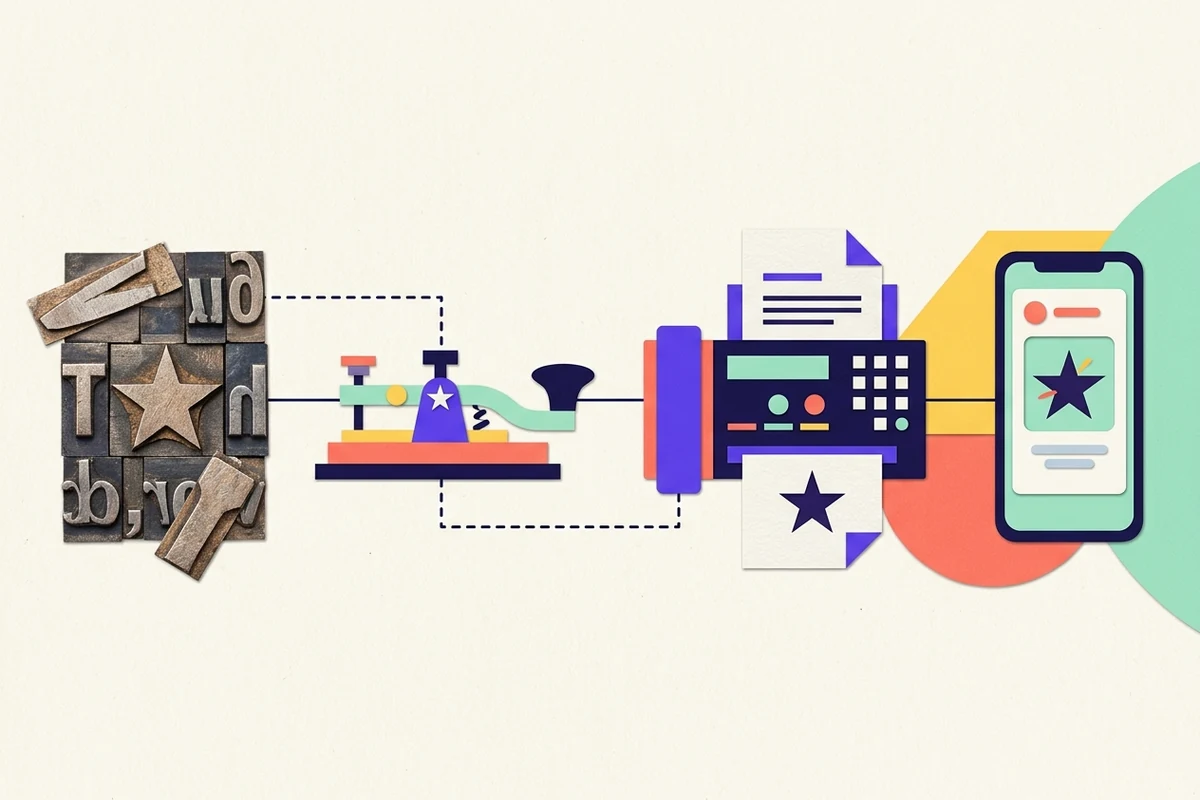
From printers' dingbats to Instagram bios. How a set of typesetting marks became the decorative vocabulary of the internet.
The short version
Start here if you only have one minute. The full guide below explains each point.
They started in printing
Stars and hearts were typesetters' ornaments first.
Unicode imported them
They were encoded for compatibility, not decoration.
Character limits made them popular
A symbol could replace a word when space was scarce.
01
Printers needed marks that were not letters
Long before computers, typesetters kept trays of ornaments: fists pointing at a paragraph, stars separating sections, hearts and clubs for playing card work.
These were called dingbats. They existed because a printed page needs punctuation of the eye as well as the sentence, and letters could not provide it.
02
Early computers had almost none of them
ASCII, standardised in the 1960s, allowed 128 characters. After the alphabet, digits and punctuation, there was no room for ornament.
So the asterisk did everything. It marked footnotes, separated sections, stood in for a bullet and served as a wildcard, purely because it was the only decorative mark available.
- 128 characters total in ASCII
- No stars, hearts, arrows or bullets
- The asterisk absorbed every decorative job
03
Unicode brought the ornaments back
When Unicode was designed in the late 1980s, it had to be able to represent everything the systems it replaced could. That meant importing whole existing collections wholesale.
The Zapf Dingbats typeface, Japanese broadcasting symbols, mathematical operators and card suits all arrived that way. The decorative set exists because of a compatibility requirement, not a design decision.
✦Almost nothing in the popular decorative set was encoded to be decorative. It was encoded so an older system's text could survive the move.
04
Japanese phones changed everything
In 1999 a Japanese mobile carrier shipped a small set of picture characters for its pager and phone service. They were designed for a tiny screen and a limited network.
When Apple and Google needed to support Japanese phones, those pictures had to be encoded. Emoji entered Unicode in 2010 through the same compatibility door as the dingbats.
05
Then character limits made them useful
Text messages, early Twitter and profile bios all had hard limits. A symbol that replaced a word or a line break was worth real space.
That is the moment decorative symbols became mainstream. Scarcity of space, not availability of characters, is what drove adoption.
06
What the history explains
It explains the odd formal names. A heart is called BLACK HEART SUIT because it came from a deck of cards, and in Unicode names black means filled.
It also explains reliability. The symbols with the deepest font support are the oldest imports, which is why a 1990s dingbat is a safer choice than a recent emoji.
Where the popular decorative characters came from
Each group entered Unicode from an existing system. The date is the Unicode version that first encoded it.
| Group | Origin | Encoded |
|---|---|---|
| Card suits ♠ ♥ ♦ ♣ | Playing cards and printers' sorts | Unicode 1.0, 1991 |
| Dingbats ✔ ✈ ✂ | Zapf Dingbats typeface, 1978 | Unicode 1.0, 1991 |
| Arrows ← → ↑ ↓ | Mathematics and technical printing | Unicode 1.0, 1991 |
| Emoji 😀 🎉 | Japanese mobile carriers, 1999 | Unicode 6.0, 2010 |
The 1991 groups have had more than thirty years of font support. That head start, not any design quality, is why they render more reliably than emoji.
07
Copy the symbols discussed in this guide
This guide explains the topic. Use aesthetic symbols for the main copyable set, compare it with star symbols, and browse heart symbols for another useful angle. Each collection includes searchable Unicode names and HTML references.
08
Questions, answered
Who invented cool symbols?+
Nobody in particular. Most were absorbed into Unicode from printing traditions, older character sets and Japanese mobile phones, then adopted for decoration by users.
Why do symbol names sound so strange?+
The names describe the character's original job, not its modern use. BLACK HEART SUIT refers to playing cards, and black means filled rather than coloured.
When did symbols become popular online?+
Character-limited spaces did it — text messages, early Twitter and profile bios — because a symbol could replace a word or a line break.
09
Sources and review notes
Character identities were checked against Unicode charts; contextual guidance distinguishes standardized names from broader cultural use.